
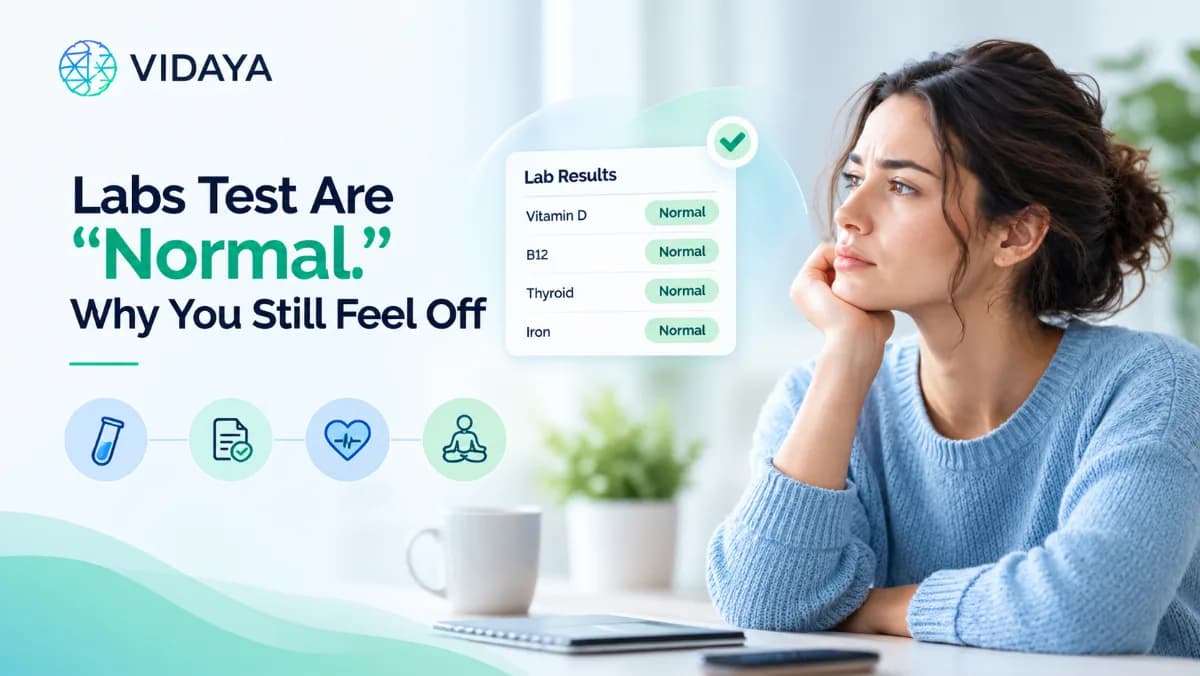
Your Lab Tests Are "Normal." Why Do You Still Feel Off?
A lab report marked "normal" should be reassuring. For many people, it is not. The numbers are in range, but the fatigue, the brain fog, or the low mood is still there.
This is a common situation. When lab test results are normal, but symptoms continue, the report isn't wrong. It is incomplete. MedlinePlus, from the U.S. National Library of Medicine, notes that a result within the reference range does not always guarantee good health.
This guide explains what "normal" means on the blood tests lab report and what to do next. It covers four practical steps: getting the full report as a PDF, reading each column, comparing reports from two labs, and knowing when to see a doctor.
New to lab reports? Start with the basics in Blood Test Results Explained, then come back here.
What "Normal" Means on a Lab Report
"Normal" has a narrow meaning. It means your number sits inside a reference range.
A reference range in blood tests lab report is the set of high and low values considered normal. The range is based on test results from large groups of healthy people.
The word "normal" can be misleading. It makes two points:
A result outside the range may or may not be a sign of a health problem. Healthy people sometimes have results outside the range.
A result inside the range is not always a guarantee of good health. Some people with health problems have results that count as "normal."
So "normal" answers one question. Is this number where most healthy people's numbers are? It does not answer the question you care about. Why do I feel this way?
Four Reasons You Can Feel Off With Normal Labs
1. The Test You Need Was Not on the Panel
A basic panel checks a limited list. "All normal" only covers the tests that were run.
Iron is a good example. The NIH Office of Dietary Supplements says iron deficiency moves in stages. In the early stages, iron stores run down, but hemoglobin levels are usually still within the normal range. Hemoglobin is part of a standard blood count. Ferritin is a separate test. NIH describes ferritin as a measure of the body's iron stores. NIH also notes that inflammation can raise ferritin, so that number needs context too.
This does not mean iron is your answer. It means a short panel can miss things.
2. One Result Is One Moment
A common things that can affect a result:
Certain foods and drinks
Medicines and supplements
Hard exercise before the test
Having a menstrual period at the time of the test
Whether you followed the prep steps, such as fasting
A single report is a snapshot of one morning. It is not a film of your year.
3. Labs Are Only Part of the Picture
Lab tests do not give a complete picture of your health. Your provider also uses your physical exam, your health history, your family health history, and any imaging tests.
4. The Cause May Not Show Up in Blood
Most of the time, fatigue can be traced to one or more lifestyle issues, such as poor sleep habits or lack of exercise. Its list of possible causes also includes alcohol use, some medicines, stress, depression, anxiety, and sleep apnea.
A standard blood panel does not measure how you slept last month.
Step 1: Get Your Report as a PDF
The short summary in your portal is often not the full report. You want the full one.
Log in to your patient portal. Open "Test Results" or "Labs." Look for "Download," "Print," or "View full report." Save it as a PDF.
If an outside lab ran the test, make an account on that lab's own patient site. The full report is often there.
No portal? Ask the doctor's office or the lab for a copy. The U.S. Department of Health and Human Services says the HIPAA Privacy Rule gives you the right to get copies of your health records.
Name each file with the date and the lab. For example: 2026-09-14_LabName_CBC.pdf.
Save every report, including old ones. You will need them in Step 3.
Step 2: Read the Columns
Most lab reports use the same layout. Read it left to right.
Column | What it tells you | What to check |
Test name | What was measured | Note the exact name and any short code |
Result | Your number | Read every row, not only the flagged ones |
Flag | Often H, L, or a star | Blank usually means in range for this lab |
Units | How it was measured | Units must match before you compare anything |
Reference range | This lab's normal range | Use only the range printed on this report |
Two points matter here.
First, check your result of blood tests against the reference range printed on your own report. Do not use ranges you find elsewhere online.
Second, tests use different units. Examples such as micrograms per deciliter (mcg/dL) and picograms per milliliter (pg/mL). The same test can look very different in different units.
Also look at the top of the page. Note the collection date, the time, and whether you were fasting.
Then write down any result that sits close to the edge of its range. It is not a problem by default. It is a good question for your doctor.
Step 3: Compare Reports From Two Labs
Here is the trap. You see one number from Lab A and another from Lab B, and you compare them directly.
Labs often use different testing methods, so they often use different reference ranges. It states that you cannot compare test results from different labs. For trends over time, it recommends using the same lab.
If you already have reports from two labs, do this:
Match the test: Names and short codes differ between labs. Make sure both rows are the same test.
Match the units: If the units differ, do not convert them yourself. Ask your doctor or the lab.
Read each result against its own range: Was it in range at Lab A? Was it in range at Lab B? That is a fair question. Which raw number is bigger is not.
Note the conditions: Fasting or not. Time of day. New medicines or supplements. A hard workout the day before.
Bring both PDFs to your doctor: For future tests, try to use one lab.
A made-up example shows why. Lab A reports 40, with a range of 30 to 100. Lab B reports 52, with a range of 45 to 130. The second number is higher. But both sit near the low end of their own range. The raw numbers alone would mislead you.
When You Really Do Need a Doctor
No guide or app should delay care. Call 911 or your local emergency number if you have fatigue and any of these:
Chest pain
Shortness of breath
Irregular or fast heartbeat
Feeling that you might pass out
Severe stomach, pelvic, or back pain
Unusual bleeding, including bleeding from the rectum or vomiting blood
Severe headache
Get emergency help if your fatigue is linked to a mental health problem and you have thoughts of harming yourself. In the U.S., call or text 988.
For everything else, here is a simple rule. Call for an appointment if two or more weeks of rest, less stress, good food, and plenty of fluids have not helped your fatigue.
We add one more point. Even with a result in the normal range, you may need more testing, especially if you have symptoms.
Bring these to the visit:
Your lab PDFs, old and new
A short list of symptoms, with dates
Every medicine, vitamin, and supplement you take
Three questions: "Which tests were not on this panel?" "Should any test be repeated?" "Could sleep, a medicine, or mood explain this?"
The Bottom Line
"Normal" means your numbers sit where most healthy people's numbers sit. It does not mean you feel fine, and it does not mean you are making it up. Get the full PDF. Read every column. Compare reports with care. If two weeks of rest have not helped, book the visit.
Where an App Helps, and Where It Stops
A folder of PDFs is hard to read across. This is the part software does well.
Vidaya AI lets you upload your lab PDFs and see your results in one place. You can view them next to your wearable data, such as sleep and activity. Then you can ask Vaya Chat plain questions like
"What does this column mean?"
"Which results changed since my last report?"
"What should I ask my doctor about this result?"
Vidaya AI helps you understand your data and see patterns over time. It is not a doctor, and it does not replace one. Your data is protected with HIPAA-aligned safeguards.
It costs $89/year or $10/month. There is no free plan.
Start Understanding Your Labs With Vidaya AI→
Frequently Asked Questions
Recommended Reading
Hand-picked health intelligence connected to this topic.



Get notified of new posts
Join 100+ health-conscious readers. No spam, just new articles on longevity and optimization.