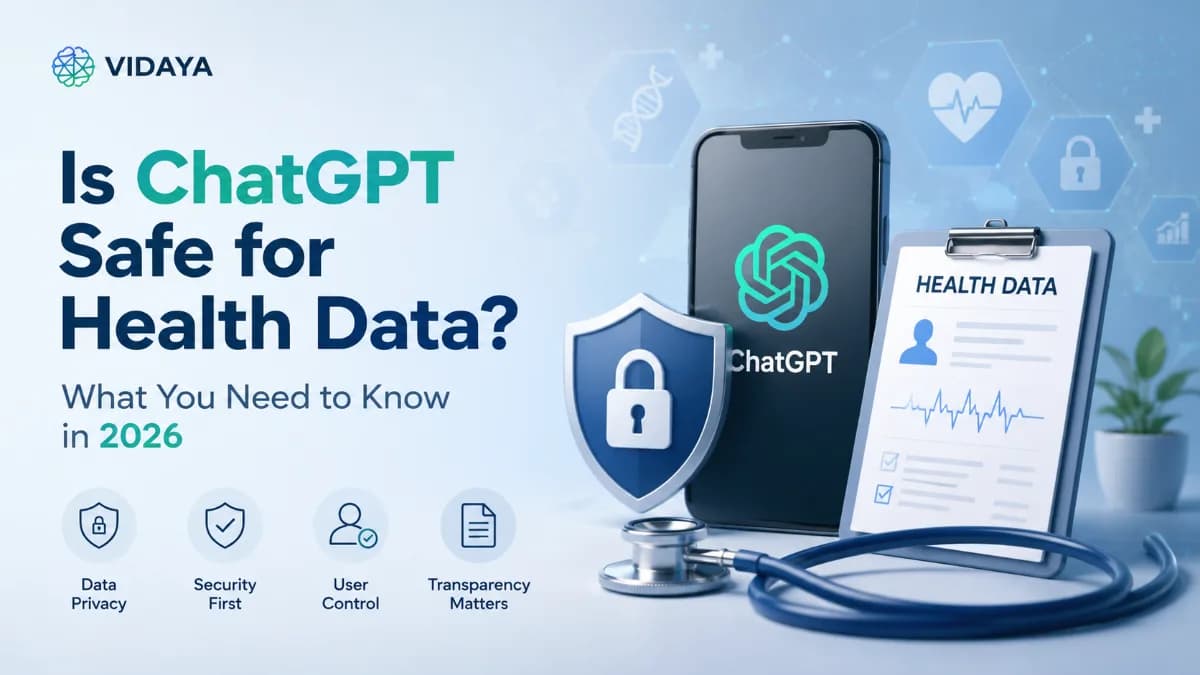
Is ChatGPT Safe for Health Data? What You Need to Know in 2026
Millions of people are typing their most personal health questions into AI chatbots every day. It is fast, available at any hour, and does not require an appointment. But before you share your lab results, symptoms, or medication list with a general-purpose AI, there are real questions worth asking about where that data goes and how reliable the answer actually is.
Why People Are Turning to ChatGPT for Health Advice
The numbers tell the story clearly. According to a March 2026 KFF Health Tracking Poll, 32% of U.S. adults now turn to AI chatbots for health information, roughly double the share from the prior year. OpenAI reported that over 230 million people globally ask health and wellness questions on ChatGPT every week, with about 70% of those conversations happening outside typical clinical hours.
The KFF poll also found that 65% of AI health users cite the desire for quick information as their primary reason, 36% feel more comfortable looking up sensitive topics privately, and 41% have uploaded personal medical information into an AI tool. That last figure is the one that warrants a closer look.
Among AI health users, 41% have uploaded personal medical information like test results or doctors' notes into a chatbot to get personalized explanations. That means 13% of the general public has handed sensitive medical data to a platform not designed to protect it. Most of them are aware of the risk: 77% of those same users say they are concerned about the privacy of that data. Beyond protecting personal information, understanding the broader privacy, security, and safety risks of AI in healthcare is essential when evaluating these technologies.
The Privacy Problem with General AI Chatbots
HIPAA is the federal law governing health data protection. It applies to covered entities: health plans, healthcare providers, and their business associates. OpenAI does not sign Business Associate Agreements for standard ChatGPT. When you type your symptoms or paste in a lab report, you are sending what would otherwise be considered protected health information to servers with no HIPAA obligation whatsoever.
That matters for a few reasons. Your prompt data may be used for model training. Data retention policies for consumer AI are often vague and do not follow healthcare standards. Even if you delete a conversation, that does not necessarily remove your data from training pipelines or system logs. ChatGPT Health, OpenAI's newer dedicated health experience, does include additional protections and states it will not train on health conversations. But that product launched in early 2026 and most casual users are not in it.
What Makes a Health AI Platform Different
A platform built specifically for health data operates under a fundamentally different set of constraints. It stores data with encryption at rest and in transit, prohibits training on your inputs, and connects to your actual health records rather than treating every conversation as a blank slate.
This is the gap that motivated building Vaya Chat in the first place. You can read more about that reasoning in why I built Vitality AI Health. The short version: general-purpose AI gives population-level answers. Health AI gives answers that know your numbers.
When you ask a general chatbot what a ferritin level of 14 means, it returns a textbook range. When you ask Vaya Chat, it places that value in context of your other biomarkers, wearable trends, and supplement history. That is the difference described in detail in what your VAI score actually means: context changes everything when you are interpreting health data.
The Accuracy Problem: Hallucinations in Clinical Settings
Privacy is not the only concern. Accuracy matters too, especially when someone is making decisions about their health.
Research published in npj Digital Medicine found that hallucinations in LLM-generated clinical notes were classified as a "major" error 44% of the time, meaning they carried meaningful risk of downstream harm if left uncorrected. The most dangerous type was negation hallucinations, where the model states the opposite of what was said, occurring most often in the planning section of clinical notes. A general chatbot confident in a wrong answer looks exactly the same as one that is right.
ChatGPT is excellent at explaining common conditions, summarizing research, and helping you prepare questions for a doctor. It is far less reliable when asked to interpret your specific numbers or draw connections across multiple test results. That is not a criticism of the technology; it is just what the research shows about how these models behave outside their comfort zone.
5 Questions to Ask Before Sharing Health Data with AI
1. Is this AI HIPAA covered?
Most consumer AI tools are not, and that is a distinction that matters practically. Under HIPAA, covered entities must implement specific safeguards, limit data use to the minimum necessary, and give you rights to access or correct your records. Before uploading a lab result or describing a chronic condition, check whether the platform has signed a Business Associate Agreement or publishes specific HIPAA compliance documentation. The absence of a clear answer is itself an answer.
2. Does it train on your inputs?
OpenAI's standard ChatGPT may use conversations to improve its models, though users can opt out in settings. The newer ChatGPT Health product explicitly states it does not train on health conversations. Purpose-built health platforms typically prohibit this entirely as a foundational policy, not an optional setting. You want to know this before you type, not after.
3. Can it cite the source of medical claims?
An AI that tells you something about your ferritin or thyroid levels without pointing to a clinical guideline is asking you to take its word for it. General-purpose models frequently present synthesized answers with high confidence and no source attribution. A health-focused platform should trace its interpretations back to your actual lab values, published reference ranges, and peer-reviewed research. If you ask "why did you say that?" and the answer is essentially "because I am trained to," that is a meaningful limitation when health decisions are involved.
4. Does it know your other data?
Context is the difference between a generic answer and a useful one. A ferritin of 14 reads differently in someone with normal CRP and good energy than in someone with elevated inflammation markers and fatigue. General chatbots work only with what you paste into the current conversation, with no memory of last month's bloodwork or the trend in your HRV over the past quarter. Platforms that integrate with your labs and wearables can spot patterns across time rather than interpreting each data point in isolation.
5. What happens if it gives you wrong advice?
General-purpose AI carries no clinical liability and explicitly discourages reliance for medical decision-making in its terms of service. That disclaimer exists for a reason. If you follow wrong advice and it harms you, practical recourse is minimal. A well-designed health AI should flag when a question is beyond its appropriate scope and prompt you to talk to a provider. Watch for that behavior, or its absence, when evaluating any health AI tool.
How These Tools Actually Compare
ChatGPT (Free/Plus)
Vaya Chat (Vitality AI Health)
Apple Health AI (placeholder)
HIPAA scope
Not covered (standard); limited coverage via ChatGPT Health
Built with encrypted storage and strict access controls
Limited; Health app data stays on device but analysis features vary
Trains on your data
Opt-out available; ChatGPT Health does not train on health chats
Does not train on health data
Not used for model training
Has your labs and wearables
Via ChatGPT Health integrations (Apple Health, Function, MyFitnessPal)
Yes, directly connected to your labs, wearables, and supplement stack
Apple Health data only; limited cross-platform integration
Cites medical sources
Inconsistent; improved in recent models but not reliable
Responses grounded in your actual biomarker data and reference ranges
Limited citation in consumer-facing features
Designed for health use
General-purpose with a health mode added
Built specifically for health data from the ground up
Consumer wellness focus; not clinical
This table is honest about where the lines blur. ChatGPT Health is a real product with real privacy protections, and OpenAI has invested meaningfully in making it safer for health use. The core distinction is not safety vs. unsafe. It is general vs. specific: a platform built around your health data from day one versus a general tool with a health layer added.
What I Tell My Friends
When people ask me whether they should use ChatGPT for health questions, I tell them the same thing I tell my parents. For general questions like "what does TSH measure" or "what foods raise ferritin," ChatGPT is genuinely excellent and there is little reason not to use it. Where I get cautious is when someone is uploading a full set of labs or asking it to interpret their specific situation over time. That is where not having your actual data context, and not operating under HIPAA, becomes a real limitation rather than a theoretical one.
When I use Vaya Chat myself, it is precisely because it knows my history. The answer it gives me on a Tuesday incorporates what my numbers looked like three months ago, what I have logged in my supplement stack, and how my sleep trend compares to my HRV. ChatGPT cannot do that, not because it is a bad product, but because it was not built for it.
Use the right tool for the task. For general health literacy, ChatGPT is fine. For interpreting your personal data, you need something that actually has it.
Sources:
Recommended Reading
Hand-picked health intelligence connected to this topic.
Get notified of new posts
Join 100+ health-conscious readers. No spam, just new articles on longevity and optimization.