
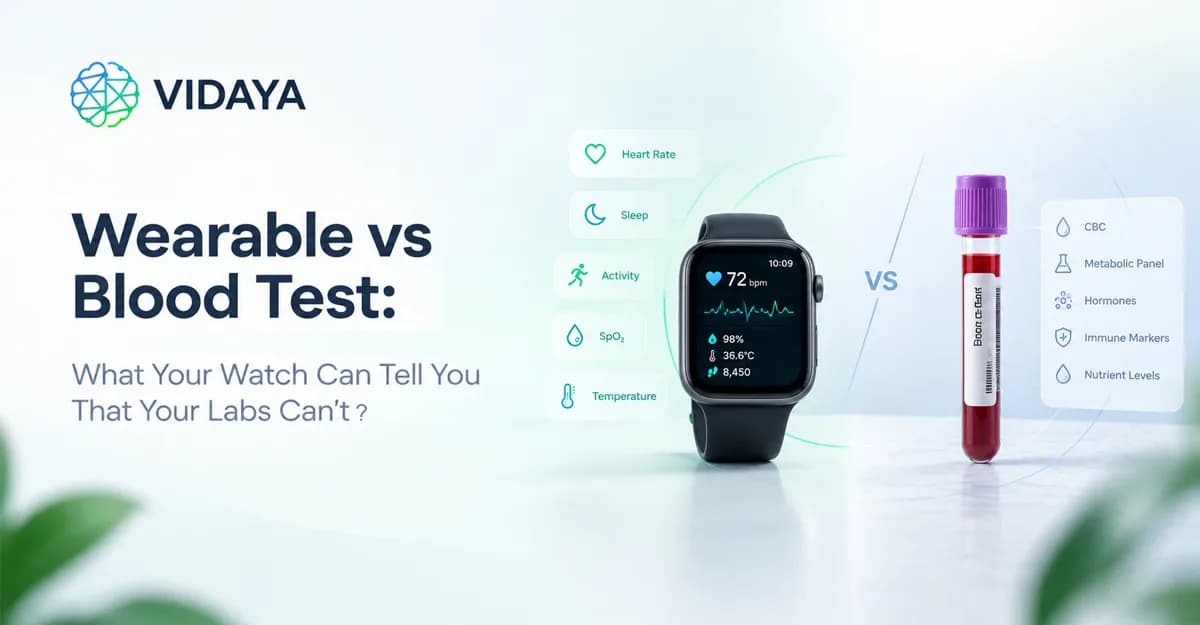
Wearable vs Blood Test: What Your Watch Can Tell You That Your Labs Can’t (and the Other Way Round)
Your watch knows how you slept last night. Your blood test knows your cholesterol. Neither one knows both.
Many people now wear a smartwatch or ring every day. So a fair question comes up: does an Apple Watch replace a blood test? The short answer is no. It also works the other way: a blood test can’t replace a watch.
They measure different things, at different speeds, with different levels of accuracy. A wearable gives you a daily signal that shows direction. A blood test gives you a precise snapshot a few times a year. Used together, they give you a fuller picture of your health than either can alone.
This guide explains what each one is good at, where each falls short, and how to use both. If you are new to reading lab reports, start with our main guide, Blood Test Results Explained.
The short answer: daily and directional vs precise and quarterly
Think of it like money. Your wearable is your daily bank balance. It changes every day and shows you which way things are moving. Your blood test is your yearly tax return. It is detailed and exact, but you only see it now and then.
A watch might record your heart rate thousands of times a day. A blood test usually happens once or twice a year, or every three months if you are tracking something closely.
Neither is “better”. They answer different questions.
What your wearable tells you that a blood test can’t
Wearables are good at one thing above all: catching day-to-day change. A blood test is a single moment. It can’t tell you how you slept on Tuesday or how your body handled a hard week.
Resting heart rate
Resting heart rate is how many times your heart beats per minute when you are still. According to the Mayo Clinic, a normal resting heart rate for adults is 60 to 100 beats per minute. Fit people often sit lower.
A wearable is useful here because it tracks your number every night. One reading means little. A rise of several beats over a week can be a pattern worth noticing. It often follows poor sleep, stress, alcohol, a hard training block or the start of a cold. A blood test can’t show you this at all.
Heart rate variability (HRV)
HRV is the small change in time between each heartbeat. It is measured in milliseconds. The NIH’s National Library of Medicine describes HRV as a reflection of your autonomic nervous system, the part that controls rest and stress responses.
There is no single “good” HRV. It depends on age, fitness and genetics. That is exactly why a wearable helps. It learns your own baseline over weeks, then shows when you move above or below it. A lab does not measure HRV.
Sleep
The NIH’s National Heart, Lung, and Blood Institute (NHLBI) says most adults need 7 to 9 hours of sleep a night. A wearable estimates how long you slept, how often you woke and how regular your sleep times are.
Wearables are not as accurate as a sleep lab. But they are good at showing patterns over time. If your sleep drops to 6 hours for two weeks, your watch will show it. Your blood test will not, even though poor sleep can affect markers like glucose.
Skin temperature
MedlinePlus notes that normal body temperature for adults usually sits between 97°F and 99°F. Many wearables track skin temperature at night. They don’t give you an exact core temperature. Instead, they show how far you are from your own normal.
A shift from your usual baseline can line up with illness, alcohol, a hot room or the menstrual cycle. It is a nudge to pay attention, not an answer.
What your blood test tells you that a wearable can’t
No watch or ring on the market today can measure what is inside your blood. That includes your cholesterol, iron, vitamins, kidney and liver function, thyroid hormones and long-term blood sugar.
Long-term blood sugar (A1c)
Hemoglobin A1c shows your average blood sugar over roughly the past three months, according to MedlinePlus. It is one of the most useful markers on a standard panel. A wearable can’t estimate it. Some people use a separate glucose sensor, but that is a different device with its own limits.
Cholesterol
The NHLBI lists an LDL cholesterol level below 100 mg/dL as optimal for most adults. You can’t feel your cholesterol. Your heart rate and sleep don’t reveal it either. Only a blood test gives you this number.
Vitamins and minerals
The NIH Office of Dietary Supplements says a vitamin D (25-hydroxy) level of 20 ng/mL or higher is adequate for bone health in most people. Low vitamin D, low iron or low B12 can leave you tired. Your watch might show lower energy or worse sleep, but it can’t tell you why. A blood test gives you the actual level.
Organ function
Kidney markers like creatinine and eGFR, liver enzymes like ALT and AST, and thyroid markers like TSH are only measured in the lab. For a full walk-through of each one, see Blood Test Results Explained. If you want to dig into kidney numbers, our guide to the BUN to creatinine ratio covers it in detail.
Wearable vs blood test: side by side
Wearable | Blood test | |
How often | Every day, often every minute | Once to four times a year |
Precision | Estimates, good for trends | Precise, lab-grade |
Best for | Heart rate, HRV, sleep, temperature, activity | Cholesterol, A1c, iron, vitamins, kidney, liver, thyroid |
What it shows | Direction and change | Exact level at one moment |
Main weakness | Can’t see inside your blood | Can’t see what happens between tests |
The NHLBI notes that red blood cells live for about 120 days. That is one reason many people space blood tests about three months apart. In those 90 days, your wearable fills the gap.
Where the two stories meet
The real value comes when you read both together. Here are a few patterns people often notice.
A rising resting heart rate and low iron.
MedlinePlus lists a fast heartbeat as one possible symptom of anemia. If your resting heart rate creeps up over a month and your next blood test shows low ferritin or hemoglobin, those two facts may be connected. That is a pattern to bring to your doctor.
Short sleep and higher glucose.
If your watch shows weeks of poor sleep and your fasting glucose comes back higher than usual, it is worth asking whether one affected the other.
Low HRV during a heavy training block.
If your HRV drops for weeks and your blood test shows signs of strain, your body may need more rest.
None of these are a diagnosis. They are patterns. They help you ask better questions. This is also why a “normal” lab result does not always mean you feel normal. We cover that in Your Labs Are Normal, But You Still Feel Off.
So, does an Apple Watch replace a blood test?
No. An Apple Watch, Oura Ring, Whoop or Garmin can’t measure cholesterol, A1c, iron, vitamin D, kidney function or thyroid hormones. These need a blood sample and a lab.
But a blood test can’t replace your watch either. Three or four snapshots a year will miss the weeks when your sleep fell apart or your resting heart rate climbed.
If you are choosing a device, our guide to the best health wearables of 2026 compares the main options.
How to use both together: 4 simple steps
1. Wear your device every night:
Most wearables need around two weeks of data to learn your baseline. Gaps make trends harder to read.
2. Test your blood on a regular schedule:
Many people test every three to six months. Use the same lab when you can, so the ranges match.
3. Note big changes before each test:
A new training plan, a stressful month, illness or a diet change can all move your numbers.
4. Look at both in one place:
It is hard to compare a sleep graph in one app with a PDF in your email. Putting them side by side makes patterns easier to see. Vidaya’s wearable insights page shows your watch data next to your lab history, and blood test tracking charts each marker over time.
Want to know how AI reads your lab PDF and what it can’t do? See What AI Blood Test Analysis Actually Does.
When you need a doctor, not a dashboard
Wearables and lab apps are tools for understanding your data. They are not medical care. The Mayo Clinic advises seeing a doctor if your resting heart rate stays above 100 beats per minute (tachycardia) without a clear reason.
See a doctor if:
A lab result is flagged as critical or far outside the range.
Your wearable shows a big change that lasts more than a week or two, and you feel unwell.
You have chest pain, fainting, shortness of breath or a racing heart. These need urgent care, not an app.
Bring your watch and your labs together
Your wearable tells you how you are trending. Your blood test tells you exactly where you stand. Vidaya puts both in one view, so you can see your patterns and understand your data. Ask Vaya Chat questions about your results in plain English. Your data is protected with HIPAA-aligned safeguards.
Plans are $89/year or $10/month.
Upload Your Labs and Connect Your Wearable →
Frequently Asked Questions
Recommended Reading
Hand-picked health intelligence connected to this topic.

Get notified of new posts
Join 100+ health-conscious readers. No spam, just new articles on longevity and optimization.