
What Is a Normal RBC Count? Ranges, Causes, and What Moves It
You got your blood test back. One line says "RBC" with a number like 4.6 next to it. Is that good or bad? And why is it flagged when you feel fine?
This guide covers one marker: the red blood cell count. You will learn what a normal RBC count is, what the number measures, and what makes it go up or down. Every medical fact here names its source.
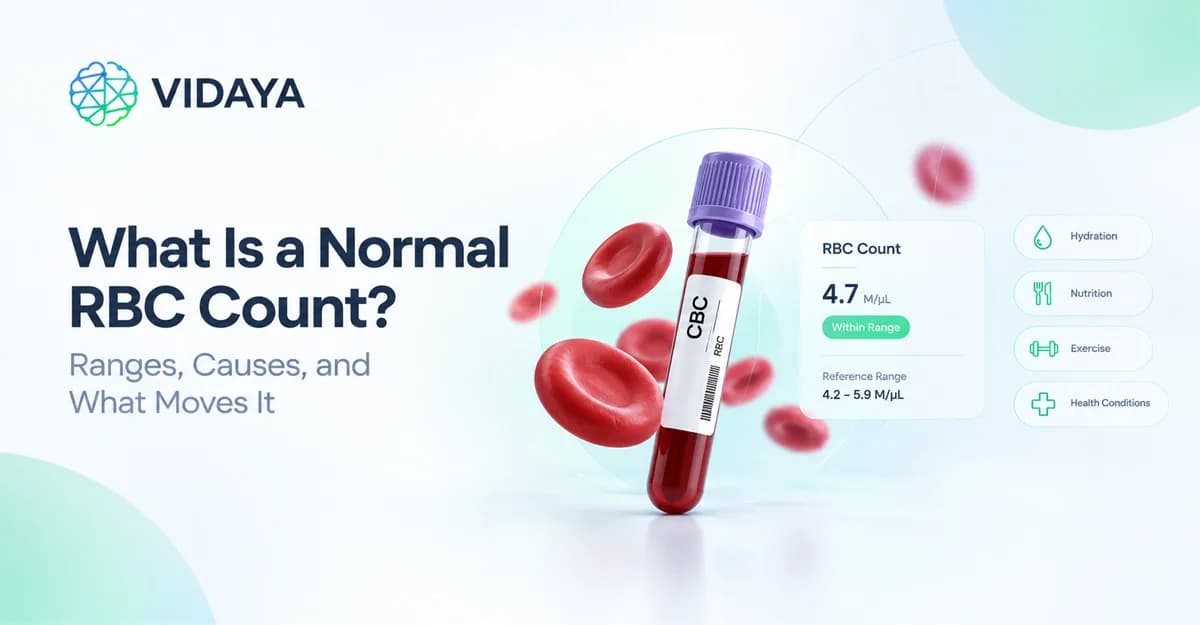
Quick answer: According to MedlinePlus, a normal RBC count is 4.2 to 5.7 million cells per microliter (mcL) for men and 3.8 to 5.1 million cells per mcL for women. MedlinePlus also notes that ranges vary slightly between labs. So always compare your result to the range on your own report.
What does an RBC count measure?
An RBC count is a blood test that counts how many red blood cells you have. Red blood cells carry hemoglobin as the protein that carries oxygen. How much oxygen your tissues get depends on how many red cells you have and how well they work.
Think of red blood cells as delivery trucks. The RBC count tells you how many trucks are on the road. It does not tell you how full each truck is. That is why doctors look at other numbers too.
The RBC count is almost always part of a complete blood count (CBC). For a full guide to every CBC marker, see the CBC section of our blood test guide.
On your report, the RBC count sits next to a few related numbers:
Hemoglobin (Hgb): the oxygen-carrying protein inside red cells.
Hematocrit (Hct): the percent of your blood made up of red cells. Common example: a result of 42 means 42% of your blood is red cells.
Red cell indices (MCV, MCH, MCHC): These measure the size and hemoglobin content of your red cells.
The test is a simple blood draw from a vein, and no preperation is needed
Normal RBC count range for men and women
Group | Range |
Adult men | 4.2 to 5.7 million cells/mcL |
Adult women | 3.8 to 5.1 million cells/mcL |
Mayo Clinic says the usual range varies by lab. It adds that in children, the normal range depends on age and sex.
Why are the ranges lower for women? Women with periods often have lower hemoglobin. Even normal monthly bleeding can lower it slightly.
Some tips for reading your number:
Use your lab's range. Some labs use different measurements. The range on your report is the one that counts.
Check the units. Your report may show the unit in a different format. If you are unsure, ask the lab.
Small changes are common. A slightly low hemoglobin is not always a sign of illness. It can be normal for some people.
What makes your RBC count go up?
The causes of a high red blood cell count into a few groups. Low oxygen, some medicines and treatments, and blood cancers can all raise it. Less fluid in the blood can also make the count look high.
Less fluid in the blood
Dehydration: Dehydration, such as from severe diarrhea, can cause a high count. When the liquid part of blood (plasma) drops, the cells are packed more tightly. The number of red cells stays the same.
Water pills: Diuretics, a common blood pressure medicine, can have the same effect.
Low oxygen, so the body makes more red cells
The body may make more red cells when oxygen levels are low. The causes it lists include:
Smoking
Living at high altitude (MedlinePlus adds that the count rises for several weeks at a higher altitude)
COPD, including emphysema
Pulmonary fibrosis (scarring of the lungs)
Sleep apnea
Heart failure and congenital heart disease in adults
Medicines and Hormones
Anabolic steroids, erythropoietin, gentamicin, and testosterone are medicines that can raise the RBC count. Mayo Clinic also lists blood doping.
Other causes
Kidney cysts or tumors.
Fatty liver: Red cell counts can be high when too much fat builds up in the liver.
Polycythemia vera: This as a rare blood cancer. It makes the bone marrow produce too many red blood cells.
What makes your RBC count go down?
A low RBC count often points to anemia. Anemia as not having enough healthy red blood cells. Common symptoms of low hemoglobin: tiredness, pale skin and gums, shortness of breath, and a fast or irregular heartbeat.
The causes are divided into three groups. The body makes fewer red cells, destroys them too fast, or loses blood.
Blood loss
These causes are:
Bleeding in the digestive tract, such as from ulcers, cancers, or hemorrhoids
Heavy periods
Frequent blood donation
The body makes fewer red cells
Low nutrients: Low levels of iron, copper, folic acid, vitamin B6 and vitamin B12. Iron deficiency anemia is a common type of anemia.
Kidney disease: Kidney disease can cause a shortage of a hormone called erythropoietin, which lowers the count. Mayo Clinic also lists chronic kidney disease. If your kidney numbers are off too, read our guide to BUN and creatinine.
Bone marrow problems: Bone marrow failure from radiation, toxins or tumors. It also lists leukemia and multiple myeloma.
Long-term conditions: Hypothyroidism (underactive thyroid), rheumatoid arthritis, inflammatory bowel disease, and cirrhosis.
Malnutrition.
Red cells destroyed too early
Red blood cells normally last about 120 days. In hemolytic anemia, they break down sooner. Some common causes includes autoimmune problems and inherited conditions like sickle cell anemia, thalassemia, and enlarged spleen.
Read Also: How to Understand Your Blood Test Results Without a Doctor
Pregnancy and Fluids
Pregnancy: Pregnancy as a cause of a lower count. It explains that the body holds more fluid during pregnancy. This lowers the share of blood made of red cells. Mayo Clinic adds that many pregnant people get iron deficiency anemia without iron supplements.
Too much water in the body.
Medicines
These medicines can be used as ones that can lower the RBC count: chemotherapy drugs, chloramphenicol and some other antibiotics, hydantoins, methyldopa, NSAIDs and quinidine.
How doctors read your RBC count
An RBC count alone does not give the full answer. After a low result, you will likely need more tests to find the cause.
The red cell indices help narrow it down and MCV (the average size of your red cells) can suggest:
Low MCV (small cells): may be due to low iron, lead poisoning or thalassemia.
High MCV (large cells): may be due to low folate or vitamin B12, chemotherapy or liver disease.
Normal MCV: MedlinePlus lists a third type of anemia where the cells are a normal size.
A high count needs context too. Mayo Clinic says high red cell counts are most often found when people are tested for other reasons.
Your result is also just one point in time. Ask your doctor whether you should repeat the test and compare the two results.
When should you see a doctor?
Talk to your doctor about any result outside your lab's range. MedlinePlus advises asking your provider what your specific result means.
Mayo Clinic suggests making an appointment if you have signs of low hemoglobin:
Tiredness
Pale skin and gums
Shortness of breath
A fast or irregular heartbeat
For a high count, Mayo Clinic lists these possible signs of polycythemia vera:
Headache, dizziness or tiredness
Blurred vision
Itching, mostly after a warm bath or shower
Feeling full soon after eating
Do not start iron pills on your own. Mayo Clinic advises seeing a doctor rather than handling iron deficiency anemia by yourself.
The bottom line
A normal RBC count is about 4.2 to 5.7 million cells/mcL for men and 3.8 to 5.1 million for women. Many things can move it. MedlinePlus and Mayo Clinic name water levels, altitude, smoking, pregnancy and some medicines. They also link larger changes to anemia, blood loss, kidney disease, lung or heart problems, and bone marrow conditions.
Read your RBC count next to hemoglobin, hematocrit and MCV. Then talk it through with your doctor. To see how it fits with the rest of the panel, visit the CBC section of our complete blood test guide.
Make sense of Your Numbers with Vaya Chat
Health numbers are easier to follow when you can see them over time. Vaya Chat helps you understand your data and spot patterns. Your information is protected with HIPAA-aligned safeguards. Plans cost $10 a month or $89 a year.
Understand Your Data and Spot Patterns With Vaya Chat Today!
Frequently Asked Questions
Recommended Reading
Hand-picked health intelligence connected to this topic.


Get notified of new posts
Join 100+ health-conscious readers. No spam, just new articles on longevity and optimization.