
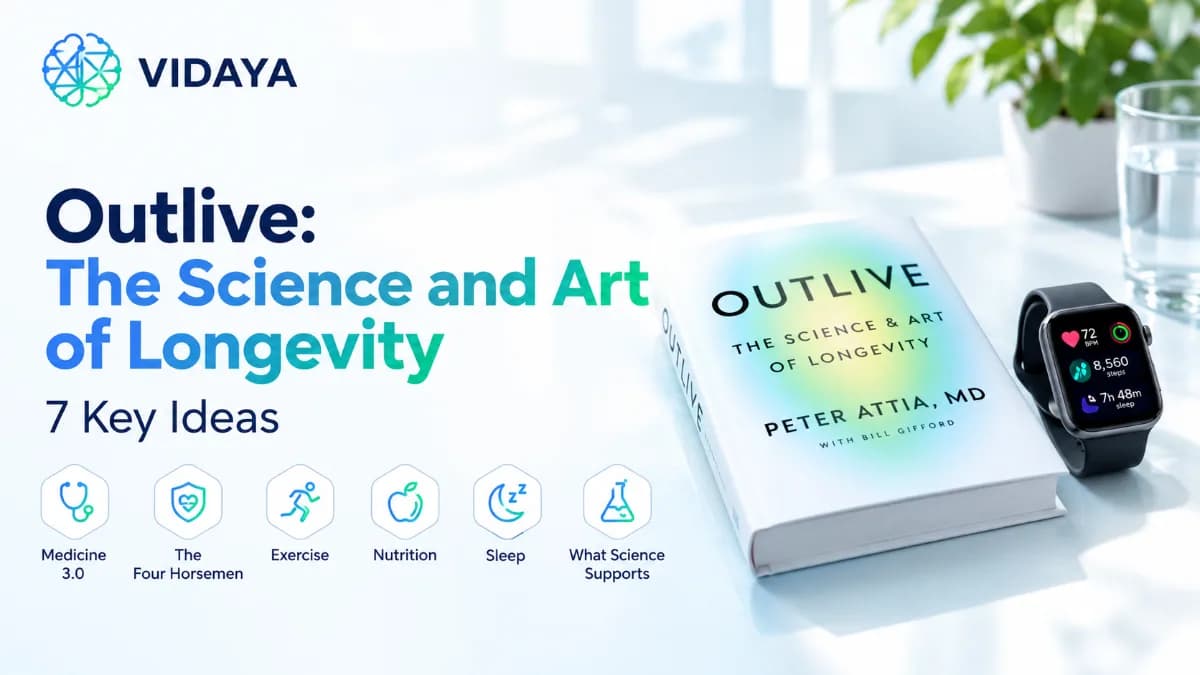
Key Ideas from Peter Attia's Book Outlive: The Science and Art of Longevity
Most people don't fear dying at 85. They fear spending their last ten years unable to lift a grandchild, climb stairs, or remember a friend's name. That fear sits at the heart of Outlive: The Science and Art of Longevity.
Written by physician Peter Attia with journalist Bill Gifford, the Outlive book was published in March 2023. It appeared on The New York Times bestseller list in both 2023 and 2024, and The Economist named it one of the best books of 2023.
The book runs close to 500 pages across three parts and 17 chapters. This guide distills its key ideas, explains what the evidence does and doesn't support, and shows how to turn the book's framework into small, realistic steps.
Key Idea 1: Healthspan Matters as Much as Lifespan
Attia splits longevity into two parts. Lifespan is how long you live. Healthspan is how well you live, the years free from disability or disease.
He argues that modern medicine has stretched lifespan without protecting healthspan. Many people spend their final decade in what he calls the "marginal decline," a slow loss of strength, cognition, and independence. Tools that support AI blood work analysis may help people better understand their biomarkers and track changes in their health over time. Outlive aims to delay death and shrink that decline.
He further breaks healthspan into three layers:
Physical: muscle, aerobic fitness, balance, and freedom from pain
Cognitive: memory, processing speed, and focus
Emotional: relationships, purpose, and mental health
Key Idea 2: From Medicine 2.0 to Medicine 3.0
Attia describes three eras of medicine. Medicine 1.0 relied on observation and guesswork. Medicine 2.0, today's model, is excellent at acute problems such as infections, injuries, and heart attacks in progress.
Its weakness is timing. Medicine 2.0 usually waits for a diagnosis before acting. Yet chronic diseases like heart disease and Alzheimer's develop silently over decades.
Medicine 3.0 is his proposed alternative. It is:
Preventive: acting years before symptoms appear
Personalized: based on your genes, labs, and history, not population averages
Risk-aware: accepting that doing nothing is also a choice with risks
Patient-led: focused on habits such as exercise, nutrition, and sleep, not only on prescriptions
In practice, this means earlier and broader screening, tracking biomarker trends over time, and treating risk factors like high ApoB or insulin resistance aggressively and early.
Key Idea 3: The Four Horsemen of Chronic Disease
Attia argues that most deaths among non-smokers in wealthy countries trace back to four slow-moving conditions. He calls them the Four Horsemen.
Horseman | What it includes | Attia's main prevention levers |
Heart and blood vessel disease | Heart attack, stroke | Lower ApoB, test Lp(a) once, control blood pressure, no smoking |
Cancer | Many types, often linked to metabolic health | Screening earlier than standard guidelines, avoid smoking, manage weight and insulin |
Neurodegenerative disease | Alzheimer's, Parkinson's | Exercise, sleep, metabolic health, knowing your ApoE4 status |
Metabolic dysfunction | Insulin resistance, type 2 diabetes, fatty liver | Exercise, muscle mass, diet quality, calorie balance |
The fourth horseman matters most because it feeds the other three. In Attia's view, insulin resistance and fatty liver disease raise the odds of heart disease, several cancers, and dementia. Metabolic health is therefore the common thread through the whole book.
His practical message is simple: start earlier than you think. Atherosclerosis can begin in early adulthood. Alzheimer's-related changes may start in the brain 10 to 20 years before memory problems show up. Waiting until your 60s to care about these risks often means waiting too long.
Key Idea 4: Exercise Is the Most Powerful Longevity Tool
If you remember one thing from Outlive, make it this. Attia calls exercise the tactic with the greatest power to shape how you live the rest of your life.
The research behind him is strong. A Taiwanese study of over 416,000 adults found that about 15 minutes of daily exercise (around 92 minutes a week) was linked to a 14% lower risk of death from any cause and about three extra years of life expectancy.
Fitness level matters even more than activity minutes. In a Cleveland Clinic study of 122,007 treadmill-tested adults, people in the lowest fitness group had roughly five times the risk of death of those in the top group. Low fitness carried a risk comparable to or greater than smoking and diabetes. Keep in mind these are observational studies: they show strong links, not proof of cause.
The Four Pillars of Attia's Training Plan
Pillar | What it is | Attia's typical target |
Zone 2 aerobic training | Steady effort where you can talk, but not comfortably | About 3 hours a week, often as four 45-minute sessions |
VO2 max training | Hard intervals near your maximum | One session a week, e.g. 4 rounds of 4 minutes hard, 4 minutes easy |
Strength training | Heavy lifting focused on grip, legs, pulling, and carrying | About three sessions a week |
Stability | Balance, posture, breathing, and controlled movement | Built into most sessions to prevent injury |
The Centenarian Decathlon
Attia's most memorable tool is the centenarian decathlon. Picture ten physical tasks you want to do in your last decade: carrying groceries up stairs, getting up off the floor, lifting a 13-kg suitcase into an overhead bin, or picking up a grandchild.
Then work backward. Strength and fitness decline with age, so you need to train well above those levels now. Exercise stops being about appearance and becomes training for the life you want at 85.
If you're new to exercise, these targets are a destination, not a starting point. Even a few weekly walks and two short strength sessions capture much of the early benefit.
Key Idea 5: Nutrition Is Personal, and Protein Matters
Readers expecting a single "Outlive diet" will be surprised. Attia, once a high-profile keto advocate, now avoids prescribing any one diet. He calls the field "nutritional biochemistry" and admits that much nutrition science relies on weak observational data.
His framework comes down to three levers:
Calorie restriction: eat less overall
Dietary restriction: cut specific foods, such as refined carbs or alcohol
Time restriction: limit the hours you eat
All three can work. The best one is the one you can sustain. On fasting, Attia is notably cautious: he warns that long-term fasting can cost muscle, which is hard to rebuild later in life.
Protein is where he takes a firm stand. He argues that the standard recommendation of 0.8 g per kg of body weight is a floor for avoiding deficiency, not a target for healthy aging. He suggests roughly 1.6 g per kg per day (about 0.7 g per pound) or more, spread across meals, especially for older adults who lift weights. Some reviewers find this aggressive, and people with kidney disease should talk to a doctor first.
He also encourages people to experiment with tools like a continuous glucose monitor (CGM) to see how specific foods affect them. That idea is popular, but evidence that CGMs improve outcomes in people without diabetes is still limited.
Key Idea 6: Sleep Is a Non-Negotiable Pillar
Attia admits he once treated sleep as wasted time. Outlive reverses that view. Poor sleep is linked to insulin resistance, weight gain, heart disease, and a higher risk of cognitive decline.
His practical advice is familiar but useful: aim for about 7 to 8.5 hours, keep a consistent schedule, keep the bedroom cool and dark, avoid alcohol and late meals, and get screened for sleep apnea if you snore or wake tired.
Key Idea 7: Emotional Health Is Part of Longevity
The most personal chapter covers Attia's own struggles with anger, anxiety, and depression, and his time in treatment. His point is blunt: a longer life is not worth much if you're miserable living it.
He treats emotional health as a skill to train, using therapy, mindfulness, and stronger relationships.
Read Also: Wearable vs Blood Test: What Your Watch Can Tell You That Your Labs Can’t
What Critics Say About Outlive
Outlive is widely praised, but a balanced read should note its limits:
Demanding Targets
Some reviewers argue the full exercise plan is too intense for beginners and that the protein targets are on the high side (Deus Ex Vita).
Testing Beyond Guidelines
A review summarized on Wikipedia argues that some of Attia's screening and medication suggestions lack strong evidence and may carry risks of their own.
Access and Cost
Advanced scans, genetic tests, and frequent lab work aren't affordable or available for most people.
Uneven Sourcing
Critics note that a few claims are thinly cited, and that the microbiome gets little attention (The Whole Health Practice).
None of this undercuts the core message. Exercise, sleep, good nutrition, and early attention to risk factors are among the best-supported health habits there are. Treat the more aggressive testing and medication ideas as conversations to have with your doctor, not as instructions.
How to Apply Outlive's Ideas: A Simple Starting Plan
You don't need a longevity clinic to use this book. Start with the steps that carry the most benefit for the least cost:
Write your own centenarian decathlon: List five to ten things you want to do at 80 or 90. Let that list shape your training.
Move most days: Build toward 150 minutes of steady cardio a week. Brisk walking, cycling, or swimming all count.
Lift twice a week: Focus on squats, hinges, pushes, pulls, and carries. Add grip work like farmer's carries.
Add one hard session: Once you have a base, try short intervals that leave you breathing hard.
Raise your protein: Include a solid protein source at every meal instead of loading it all at dinner.
Protect your sleep: Set a consistent bedtime and stop eating two to three hours before it.
Ask your doctor about key labs: Useful markers to discuss include ApoB, Lp(a), HbA1c, fasting insulin, blood pressure, and liver enzymes.
Invest in relationships: Social connection and purpose are part of the plan, not extras.
Track a few simple measures every three to six months, such as resting heart rate, grip strength, waist size, and how far you can walk in six minutes. Progress on these matters more than any single test result.
Final Thoughts
Outlive: The Science and Art of Longevity asks a useful question: what will your body and mind need to do in your last decade, and what are you doing now to prepare? Its answers aren't magic. They are mostly consistent exercise, enough protein, good sleep, strong relationships, and taking risk factors seriously years before they become diseases.
You don't have to adopt every protocol to benefit. Pick one habit from this guide, start this week, and build from there.
Frequently Asked Questions
Recommended Reading
Hand-picked health intelligence connected to this topic.



Get notified of new posts
Join 100+ health-conscious readers. No spam, just new articles on longevity and optimization.