
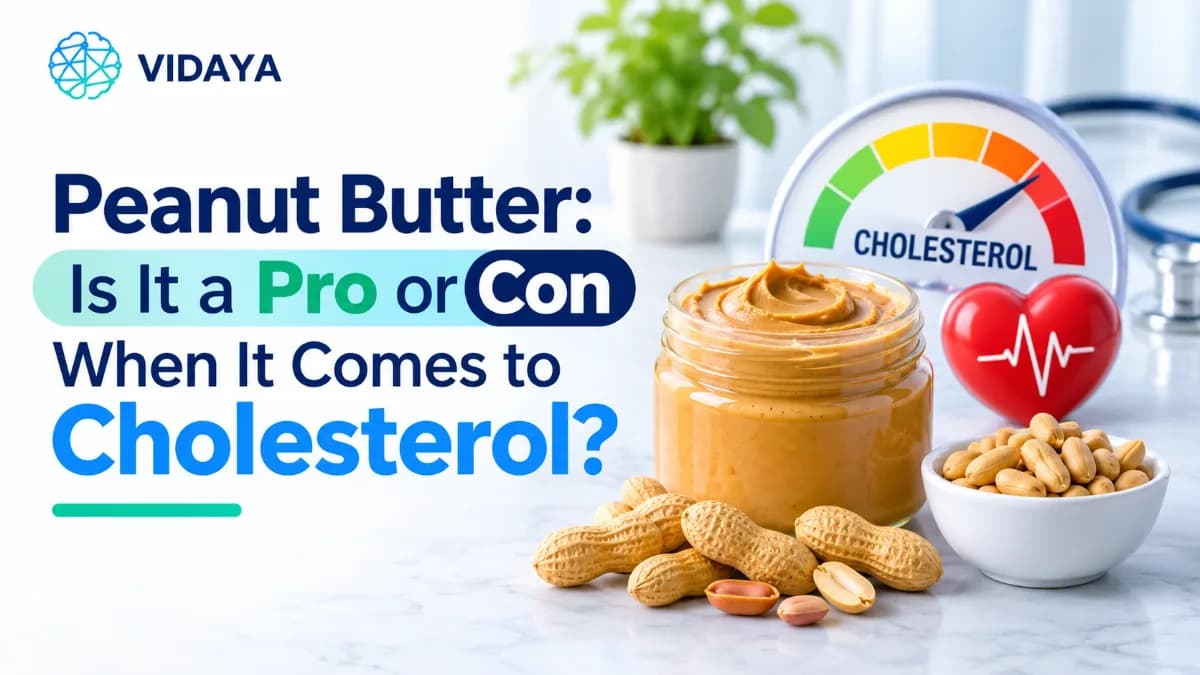
Peanut Butter: Is It a Pro or Con When It Comes to Cholesterol?
Is peanut butter bad for cholesterol? It is one of the first questions people ask after a routine blood test comes back with a higher LDL number than expected. Peanut butter sits in an awkward spot. It is dense in calories and high in fat, which makes it look suspicious. Yet it is also a plant food, and plant foods tend to have a reputation for being kind to the heart.
The short answer: plain peanut butter is not bad for cholesterol for most people. It contains no dietary cholesterol, and most of its fat is the unsaturated kind linked to healthier blood lipids. The longer answer depends on three things: what is in the jar, how much ends up on the spoon, and what the rest of the plate looks like.
This article covers what a serving of peanut butter actually contains, what clinical trials show about its effect on LDL, HDL and triglycerides, where the genuine downsides sit, and how to pick a jar that supports heart health. It also looks at how people who track their own biomarkers can check whether a food like peanut butter is helping or hurting their numbers, rather than relying on general advice alone.
Does Peanut Butter Contain Cholesterol?
No. Peanut butter contains 0 mg of cholesterol, because dietary cholesterol is made only by animals. Meat, eggs, dairy and seafood carry it. Peanuts, like avocados, olives and every other plant food, do not.
That fact surprises many people, and it points to a common mix-up. Two different things share the same name:
Dietary cholesterol is the cholesterol present in food.
Blood cholesterol is the waxy substance the liver makes and ships through the bloodstream inside lipoproteins such as LDL (low-density lipoprotein) and HDL (high-density lipoprotein).
A standard blood test reports the second kind. Anyone unsure what each line on that report means can start with this guide to understanding a lipid panel, which explains LDL, HDL, triglycerides and total cholesterol in plain terms.
For most people, the foods that raise LDL the most are not the ones richest in dietary cholesterol. They are the foods high in saturated and trans fats. These fats nudge the liver to make more LDL and slow down how quickly it is cleared from the blood. So the more useful question is not only whether peanut butter contains cholesterol, but what kind of fat it contains and how much.
On that measure, peanut butter does reasonably well. About three-quarters of its fat is unsaturated, and roughly one-fifth is saturated. That ratio is the heart of the whole debate.
What Is Inside a Serving of Peanut Butter?
A standard serving is 2 tablespoons (32 g), which delivers about 190 calories, 7 g of protein and 3.3 g of saturated fat. The figures below are for smooth, unsalted natural peanut butter, based on the USDA values reported by Healthline.
Nutrient | 1 tbsp (16 g) | 2 tbsp (32 g) |
Calories | 96 | 192 |
Cholesterol | 0 mg | 0 mg |
Protein | 3.6 g | 7.1 g |
Carbohydrates | 3.6 g | 7.1 g |
Fiber | 0.8 g | 1.6 g |
Total fat | 8.2 g | 16.4 g |
Saturated fat | 1.7 g | 3.3 g |
Monounsaturated fat | 4.2 g | 8.3 g |
Polyunsaturated fat | 2.0 g | 4.0 g |
The macronutrients tell only part of the story. Peanuts also supply folate, niacin, magnesium, manganese, selenium, vitamin E, the amino acid arginine, and plant compounds such as polyphenols and phytosterols, according to a 2022 review in Frontiers in Nutrition.
Several of these matter directly for cholesterol and the blood vessels:
Monounsaturated fat, mostly oleic acid (the same fat found in olive oil), is linked to lower LDL when it replaces saturated fat in the diet.
Polyunsaturated fat, mainly linoleic acid, also helps lower LDL when it takes the place of saturated fat.
Phytosterols have a structure similar to cholesterol and compete with it for absorption in the gut, so less dietary cholesterol makes it into the bloodstream.
Fiber slows digestion and supports a healthier gut. Some types bind bile acids, which pushes the liver to pull more cholesterol from the blood to make new ones.
Arginine is a building block for nitric oxide, a molecule that helps blood vessels relax.
Magnesium and vitamin E support normal blood pressure and help protect LDL particles from oxidation, a step involved in plaque formation.
None of these turns peanut butter into a medicine. Together, though, they explain why researchers keep finding that peanuts sit on the helpful side of the ledger.
What Does the Research Say About Peanut Butter and Cholesterol?
The weight of evidence suggests that peanuts and peanut butter are neutral to helpful for blood lipids, especially when they replace foods high in saturated fat or refined carbohydrates. Four pieces of research shape that view.
The FDA's qualified health claim
In 2003, the US Food and Drug Administration allowed peanuts and several tree nuts to carry a qualified heart-health claim. The wording, reported by Natural Products Insider, says evidence suggests but does not prove that eating 1.5 ounces a day of most nuts, such as peanuts, as part of a diet low in saturated fat and cholesterol may reduce the risk of heart disease. "Qualified" is the key word: the evidence was promising, not conclusive. The condition attached to it matters just as much. The benefit is tied to an overall eating pattern, not to peanuts alone.
A large review of 139 trials
A 2023 systematic review and meta-analysis in Advances in Nutrition pooled 139 randomized controlled trials on tree nuts and peanuts. Eating nuts led to significant drops in LDL cholesterol, total cholesterol, triglycerides, the total-to-HDL cholesterol ratio, the LDL-to-HDL ratio and apolipoprotein B (apoB). ApoB is worth noting. Many cardiologists now treat it as a sharper marker of heart risk than LDL alone, because it counts the number of particles that can enter artery walls.
The ARISTOTLE trial on peanuts and peanut butter
Researchers at the University of Barcelona ran a six-month randomized trial, called ARISTOTLE, with 63 healthy adults. Participants kept their usual diet and added either 25 g of skin-roasted peanuts, 2 tablespoons (32 g) of peanut butter, or 2 tablespoons of a control butter made from peanut oil each day. The published results showed lower total-to-HDL and LDL-to-HDL cholesterol ratios in the whole-peanut group compared with the control group.
Peanut butter and type 2 diabetes
A 2002 study in the Journal of the American Medical Association, drawn from the long-running Nurses' Health Study, found that women who ate peanut butter more than five times a week had a significantly lower risk of type 2 diabetes than women who rarely ate it. The study was observational, so it shows an association rather than proof of cause. It is still relevant to cholesterol. Insulin resistance tends to travel with high triglycerides, low HDL and small, dense LDL particles, so foods that support steady blood sugar often support a better lipid profile too.
What the evidence does not say
No study shows that adding large amounts of peanut butter to an otherwise poor diet will fix high cholesterol. The benefits appear when peanut butter displaces something worse, such as butter, cream cheese, processed meat or sugary snacks. The foods with the strongest track record are covered in this list of foods that help lower LDL cholesterol.
The Cons: Where Peanut Butter Can Work Against Cholesterol
Peanut butter's risks rarely come from the peanut itself. They come from portion size, what manufacturers add to the jar, and what it gets spread on. Here are the main ones.
1. Saturated fat adds up
Two tablespoons carry about 3.3 g of saturated fat. The American Heart Association recommends an eating pattern with less than 6% of calories from saturated fat. On a 2,000-calorie diet, that works out to about 13 g a day. One serving of peanut butter uses roughly a quarter of that budget. That is fine on its own, but it leaves less room for butter, cheese, red meat or baked goods later in the day.
2. It is easy to overeat
At around 190 calories per 2 tablespoons, peanut butter is one of the most calorie-dense foods in a typical kitchen. Few people measure it. A generous spoonful straight from the jar can easily be 3 or 4 tablespoons. Over weeks, a steady calorie surplus leads to weight gain, and extra body fat, especially around the waist, tends to raise LDL and triglycerides while lowering HDL.
3. Added sugar
Many popular brands add sugar, corn syrup, molasses or honey. A few grams per serving may not sound like much, but diets high in added sugar are linked to higher triglycerides. Flavored versions, such as honey-roasted or cinnamon swirl, usually carry the most.
4. Added oils and hydrogenated fats
So-called no-stir peanut butters often contain palm oil or hydrogenated vegetable oils to stop the natural oil from separating. Palm oil is high in saturated fat. Partially hydrogenated oils are the main source of artificial trans fats, which raise LDL and lower HDL at the same time. They have been largely phased out of the US food supply, but they can still appear in some imported products. Fully hydrogenated oils contain very little trans fat, yet they behave like saturated fat.
5. Sodium
Salt does not raise cholesterol, but it can raise blood pressure, which adds to overall heart risk. Some brands contain 140 mg or more of sodium per serving. Unsalted versions exist and taste better than most people expect after a week or two.
6. Its companions on the plate
Peanut butter on white bread with jam is a very different meal from peanut butter on whole-grain toast with sliced banana. The first pairs it with refined starch and sugar. The second adds fiber and slows the rise in blood sugar.
7. Chocolate and flavored nut spreads
Chocolate hazelnut spreads and similar products are often marketed alongside nut butters, but they usually list sugar as the first ingredient. They contain some nuts, yet they carry far more sugar and calories than true nut butters. They are better treated as a dessert than as a heart-friendly staple.
Peanut Butter vs Almond Butter vs Cashew Butter
All three nut butters are cholesterol-free and reasonable choices in moderation, but almond butter has the edge for heart health, with the least saturated fat and the most fiber. Values are per 1 tablespoon of unsalted natural nut butter.
Nutrient (per 1 tbsp) | Almond butter | Cashew butter | Peanut butter (smooth) |
Calories | 98 | 94 | 96 |
Cholesterol | 0 mg | 0 mg | 0 mg |
Protein | 3.4 g | 2.8 g | 3.6 g |
Carbohydrates | 3.0 g | 4.4 g | 3.6 g |
Fiber | 1.6 g | 0.3 g | 0.8 g |
Total fat | 8.9 g | 7.9 g | 8.2 g |
Saturated fat | 0.66 g | 1.56 g | 1.65 g |
Monounsaturated fat | 5.2 g | 4.7 g | 4.2 g |
Polyunsaturated fat | 2.2 g | 1.3 g | 2.0 g |
A few patterns stand out:
Almond butter has about 60% less saturated fat than peanut butter, twice the fiber, and the most monounsaturated and polyunsaturated fat. For someone actively working to bring LDL down, it is the strongest of the three.
Cashew butter has slightly fewer calories and less total fat, but it has the least protein and almost no fiber. Its saturated fat is close to peanut butter's.
Peanut butter has the most protein of the three and usually costs far less than almond or cashew butter. For many households, price and availability make it the realistic everyday option.
The gap between them is smaller than the gap between a natural nut butter and a sweetened, oil-blended one. A clean jar of peanut butter is a better choice than an almond butter loaded with added sugar and palm oil.
Other spreads are worth knowing about too. Walnut butter supplies alpha-linolenic acid (ALA), a plant omega-3 fat. Sunflower seed butter is a common nut-free option for schools and for people with allergies. Tahini, made from sesame seeds, works well in savory dishes.
How Much Peanut Butter Is Reasonable?
For most adults, 1 to 2 tablespoons a day fits comfortably into a heart-healthy diet. Two tablespoons weigh about 32 g, a little over 1 ounce, which sits just under the 1.5 ounces of nuts named in the FDA's qualified claim. Anyone also eating whole nuts during the day may want to lean toward the lower end.
Measuring with an actual tablespoon for the first week or two is a simple habit that pays off. Most people are surprised by how small a level tablespoon looks next to the amount they usually scoop.
Smart ways to eat it
The goal is to pair peanut butter with fiber and whole foods, and to use it in place of something higher in saturated fat. Some practical ideas:
Stirred into oatmeal: Oats are rich in beta-glucan, a soluble fiber with solid evidence for lowering LDL. Peanut butter adds protein and keeps the bowl filling for longer.
On apple or pear slices: The fruit adds fiber and a natural sweetness, so no jam is needed.
On whole-grain toast instead of butter: This swap trades mostly saturated dairy fat for mostly unsaturated plant fat.
Blended into a smoothie with banana, spinach and unsweetened milk or soy milk.
As a savory sauce: Thinned with lime juice, garlic, ginger and a little soy sauce, it makes a satay-style dressing for vegetables, tofu, chicken or noodles.
With celery or carrot sticks as an afternoon snack that holds hunger off until dinner.
Mixed into plain Greek yogurt with berries, instead of a sweetened flavored yogurt.
People wearing a continuous glucose monitor (CGM) may see a smaller blood sugar rise when a spoonful of peanut butter is added to toast or fruit, compared with eating the carbohydrate alone. Fat and protein slow how quickly carbohydrates are absorbed. Steadier glucose over time is good news for triglycerides and HDL as well.
Know Your Numbers, Not Just the Nutrition Label with Vidaya.
General nutrition advice describes averages, and individual bodies respond differently. Two people can eat the same breakfast for three months and see their LDL move in opposite directions. Genetics, sleep, activity, body weight and the rest of the diet all play a part.
This is where connected health data becomes useful. Vidaya brings wearable data, lab results, continuous glucose readings and DNA insights into one dashboard. Instead of comparing two PDF lab reports side by side, users can see how LDL, HDL and triglycerides trend over time next to sleep, activity and glucose patterns. Vidaya's AI assistant, Vaya, can then answer plain-language questions about those trends, such as whether triglycerides have moved since a diet change started.
Turn Every Lab Test Into a Clear Next Step with Vidaya
The Bottom Line: Pro or Con?
For most people, peanut butter is a pro when it comes to cholesterol, with conditions. It contains no cholesterol, its fat is mostly unsaturated, and trials on peanuts point to modest improvements in LDL ratios and triglycerides. Those benefits hold up best when three conditions are met:
The jar contains peanuts and little else.
The portion stays around 1 to 2 tablespoons a day.
It replaces foods higher in saturated fat or refined sugar, rather than being piled on top of them.
Peanut butter turns into a con when it comes loaded with sugar and palm oil, when portions creep toward a quarter of the jar, or when it rides on white bread and jam every day. Almond butter is a slightly better option for anyone chasing the lowest saturated fat, but a clean peanut butter is still a solid, affordable choice.
The most reliable way to know how a food affects one particular body is to measure. A baseline lipid panel, one change at a time, and a retest a few months later will say more than any general rule.
Frequently Asked Questions
Recommended Reading
Hand-picked health intelligence connected to this topic.
Get notified of new posts
Join 100+ health-conscious readers. No spam, just new articles on longevity and optimization.