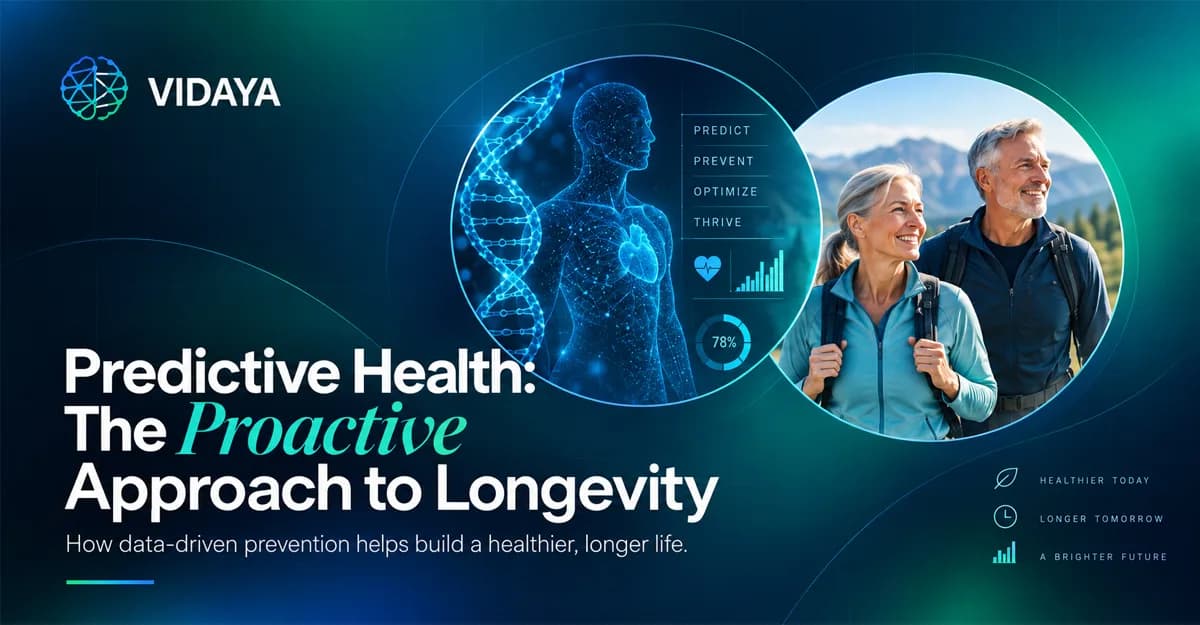
Predictive Health: The Proactive Approach to Longevity
For most of modern medicine's history, healthcare has worked in reverse: something goes wrong, symptoms appear, and only then does treatment begin. Predictive health flips that model. Instead of waiting for disease to announce itself, a proactive approach uses data, biomarkers, and early detection to identify risk years before a diagnosis would otherwise happen. It's a fundamental shift in how people think about aging and longevity.
This shift is exactly why tools like Vidaya longevity AI app built around predictive health tracking, have become so relevant. People no longer want to wait for an annual physical to learn something is wrong. This article explains what predictive health means, why a predictive health longevity proactive approach matters more than ever, and how to build it into your routine.
What Is Predictive Health?
Predictive health is an approach to medicine that uses advanced diagnostics, biomarker tracking, and pattern recognition to identify health risks before they become symptomatic disease. Rather than treating illness after it appears, predictive health focuses on understanding what's happening at the cellular and molecular level long before those changes show up on a standard checkup.
This proactive model relies heavily on data collected over time rather than a single snapshot. Trends in bloodwork, sleep quality, heart rate variability, and metabolic markers reveal far more about long-term health trajectory than any one test result in isolation. The goal isn't just to catch disease early, it's to prevent it from developing in the first place by acting on warning signs while they're still reversible.
Explore Further: Is Creatine Vegan?
Healthspan vs. Lifespan: Why the Distinction Matters
A core idea behind predictive, proactive health is the difference between lifespan and healthspan. Lifespan simply measures total years lived. Healthspan measures the years spent free of chronic disease, pain, and functional decline.
Living longer isn't much of a win if those extra years are spent managing chronic illness. Predictive health strategies aim to compress the period of decline into as short a window as possible, so people remain active, independent, and healthy for more of their lives rather than simply adding years at the end. This reframing is part of why longevity has become less about anti-aging and more about staying functional: can you still carry groceries, climb stairs, or get up off the floor without help well into your later decades?
Why a Proactive Approach Beats Reactive Care
Reactive healthcare waits for symptoms. By the time most chronic conditions become symptomatic, meaningful damage has often already occurred. A predictive health longevity proactive approach changes the timeline in several important ways:
Earlier risk detection
Expanded biomarker panels can flag metabolic risk factors like elevated ApoB or fasting insulin 5 to 15 years before conventional tests would catch a problem.
Personalized intervention
Instead of generic advice, proactive health strategies are built around your specific biology, family history, and lifestyle patterns.
Reversible changes
Many early-stage risk markers can be improved or reversed through diet, exercise, and lifestyle changes, options that shrink significantly once disease is established.
Reduced long-term cost and suffering
Preventing a chronic condition is almost always less costly, physically and financially, than managing one after diagnosis.
This is the foundation of why predictive health is gaining traction well beyond specialized longevity clinics.
Key Biomarkers and Metrics Worth Tracking
A proactive health approach depends on knowing which signals actually matter. Some of the most useful markers include:
Expanded bloodwork
Beyond standard cholesterol panels, markers like ApoB, fasting insulin, and inflammatory markers such as hs-CRP offer earlier insight into metabolic and cardiovascular risk.
Sleep architecture
Total sleep time matters less than the quality of deep and REM sleep, which wearables can now track in detail.
Heart rate variability and resting heart rate
Trends in these numbers reflect recovery capacity and overall cardiovascular resilience.
Body composition
Muscle mass and visceral fat levels are stronger predictors of long-term health than body weight alone.
Grip strength
Increasingly recognized as a simple but powerful predictor of mortality risk in adults over 50.
Tracking these markers individually is useful, but the real value comes from watching how they move together over months and years.
The Role of Technology and AI in Predictive Health
Artificial intelligence has become central to making predictive health practical for everyday people, not just patients at specialized clinics. AI can analyze complex, multi-source datasets, bloodwork, wearable data, sleep patterns, and activity levels, to detect patterns a person or even a busy physician might miss in a routine visit.
This is precisely the role a Vidaya longevity AI app plays. By pulling together lab results, wearable data, and daily habits into one continuous picture, Vidaya can surface a nine-month trend in resting heart rate or a slow drift in a metabolic marker long before it would trigger concern in an annual physical. That kind of pattern recognition, applied consistently over time, is what turns predictive health from a concept into something genuinely usable.
How to Start Building a Proactive Health Routine
Adopting a predictive health longevity proactive approach doesn't require an expensive concierge clinic. A practical starting point includes:
Get expanded bloodwork, not just a standard panel, at least once a year to catch metabolic risk factors earlier.
Wear a sleep and activity tracker consistently so trends, not single nights, guide your decisions.
Prioritize strength training, since muscle mass and grip strength are strong predictors of long-term functional health.
Log your data somewhere centralized, whether that's a spreadsheet or a longevity AI app, so patterns are visible rather than scattered across different apps and reports.
Review your trends regularly, ideally every few months, rather than only reacting when something feels wrong.
Tracking Progress Over Time
Predictive health only works if the data is actually reviewed and acted on. This is where most people struggle, not because they lack access to testing, but because scattered results across different labs, apps, and wearables are hard to interpret as a whole. A longevity AI app such as Vidaya solves this by consolidating everything into one continuously updated view, making it far easier to notice a meaningful shift instead of dismissing it as noise.
Over time, this consistent tracking builds a personal health baseline that becomes increasingly valuable. What looks "normal" for the general population may not be normal for you, and only sustained tracking reveals that difference.
Read More: What Are the Building Blocks of Proteins?
Conclusion
Predictive health represents a genuine shift away from reactive medicine and toward a predictive health longevity proactive approach built on early detection, personalized data, and consistent tracking. By focusing on healthspan rather than just lifespan, and by paying attention to biomarkers, sleep, strength, and metabolic trends well before symptoms appear, it becomes possible to catch problems while they're still reversible. Whether you start with expanded bloodwork, a wearable device, or a Vidaya longevity AI app to bring it all together, the earlier you adopt a predictive mindset, the more control you retain over your own long-term health.
Frequently Asked Questions
Recommended Reading
Hand-picked health intelligence connected to this topic.
What Your VAI Score Actually Means
Your VAI Score is a data quality score from 0-100 that tells you how much the AI can trust your health data and where the gaps are.
Why I Built Vitality AI Health
Kevin Amrelle, founder of Vitality AI Health, shares the real story behind building the platform that finally connects your fragmented health data in one place.
The Best Health Wearables in 2026: A Head-to-Head Comparison You Can Actually Use
Hands-on comparison of Apple Watch Series 11, Oura Ring Gen 4, Whoop 5.0, Garmin Fenix 8, and Fitbit Sense 3: battery life, sensor accuracy, pricing, and which one fits your actual goals.
Get notified of new posts
Join 100+ health-conscious readers. No spam, just new articles on longevity and optimization.