
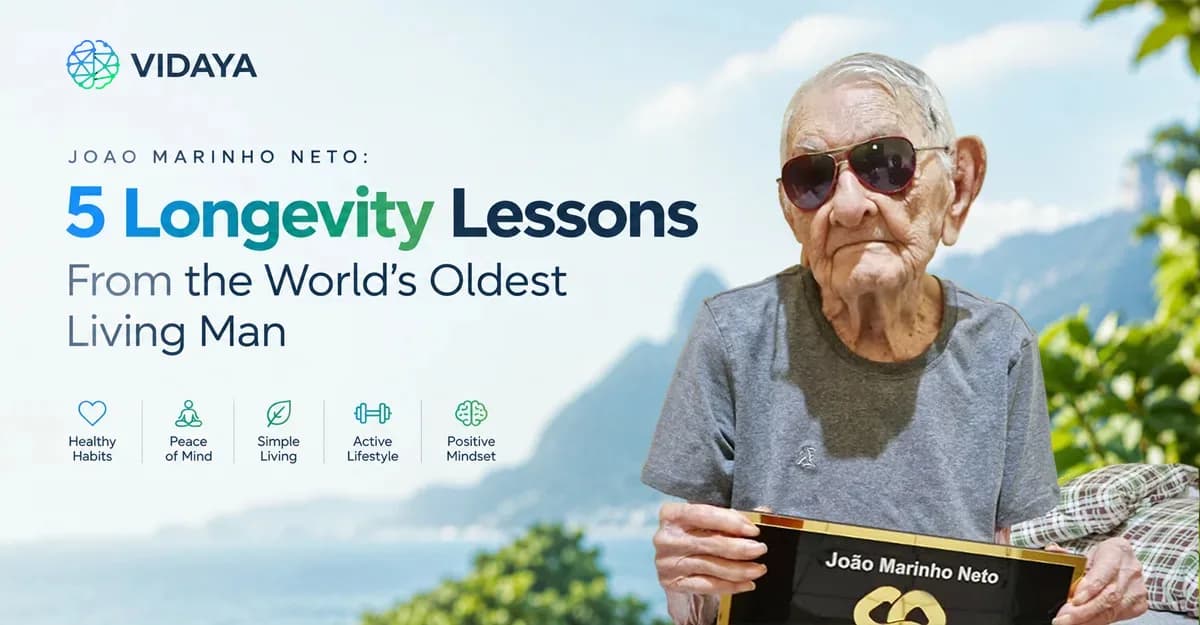
Joao Marinho Neto: 5 Longevity Lessons From the World's Oldest Living Man
Every year, the longevity industry spends billions chasing a single question: how do we live longer? We have wearables that track sleep to the minute, blood tests that estimate biological age, and supplements with impressive-sounding names. Then a 113-year-old Brazilian farmer, who has never worn a smartwatch, answers the same question in one sentence.
His name is João Marinho Neto, and as of this writing, he is the oldest living man in the world. What struck me while reading about him is how little of his story fits the "biohacker" playbook. It fits something older and simpler, and I think it is worth taking seriously.
Here are five longevity lessons from his life, based on what has been documented by Guinness World Records, LongeviQuest, and other public sources.
Read Also: Predictive Health: The Proactive Approach to Longevity
Who Is Joao Marinho Neto?
João Marinho Neto was born on 5 October 1912 in Maranguape, in the Brazilian state of Ceará. His family later moved to the rural town of Apuiarés, where he grew up in farming country. According to LongeviQuest, he began helping his father in the fields at the age of four, looking after cattle and harvesting fruit from Juazeiro trees.
He became the world's oldest living man on 25 November 2024, after the death of John Tinniswood of the United Kingdom, who was 112. Guinness World Records confirmed the title a few days later. He is also the last verified man alive who was born in 1912. In May 2025, he passed Delio Venturotti to become the oldest validated Brazilian man ever, according to Wikipedia.
At his 113th birthday in October 2025, he exchanged wishes with Ethel Caterham, then 116, in the first known communication between the world's oldest man and oldest woman. He turns 114 in two weeks.
Longevity Lessons from Joao Marinho Neto:
1. Surround Yourself With Good People
If there is one thing João says again and again, it is this. When asked about his longevity, he told reporters that the key is to "surround yourself with good people and keep your loved ones close by."
This is not just a warm sentiment. Researchers who study aging have found for years that social connection is among the strongest predictors of how long we live. Loneliness has been compared, in risk terms, to smoking. João's advice lines up with that research almost perfectly.
My interpretation: most of us optimise for inputs we can measure, like steps, calories, and heart rate variability. Relationships are harder to put on a dashboard, so we treat them as optional. João's life suggests they may be the most important metric we are not tracking.
2. Keep Your Family Close and Avoid Isolation
This is related to the first lesson, but distinct. According to LongeviQuest, he has also credited having his children near him and avoiding too much solitude.
His family is remarkable in itself. He has had seven children, six of whom are still living. His descendants include 22 grandchildren, 15 great-grandchildren, and three great-great-grandchildren. That is a household with people of five generations in it.
For readers in India, this may sound familiar. The joint family, where grandparents, parents, and children share a home or live close together, has long been a feature of Indian life. As cities grow and families spread across the country and the world, that structure is loosening. João's story is a reminder of what we risk losing when we trade closeness for convenience. Calling your parents more often, or living nearer to them where you can, might be a health decision as much as an emotional one.
3. Build a Body That Moves From Childhood
João did not go to a gym. He worked. From the age of four, he was outdoors, tending animals and harvesting fruit. Over his life, he farmed corn and beans and raised chickens, cattle, goats, and pigs.
I want to be careful here, because no source I found says that farming is his secret. But it is fair to observe that he spent most of his life doing daily, low-intensity physical work outdoors. That pattern matches what health researchers call "natural movement," the constant, unglamorous activity that fills a day without ever being called exercise.
A 2024 report from his care staff, cited on Wikipedia, noted that he had no hypertension, no diabetes, and no history of stroke or cancer. Genetics likely plays a role, as it does for most supercentenarians. But a lifetime of movement is a habit anyone can start copying today, whether that means walking after dinner or taking the stairs.
4. Stay Resilient When Life Is Hard
João did not live an easy life. He grew up and worked in the semi-arid interior of northeastern Brazil, a region known for severe droughts. He farmed through them anyway, and he managed to maintain a stable livelihood despite the harsh conditions.
He also outlived his first wife, Josefa Albano dos Santos, who died in 1994, and one of his daughters. He went on to build a second family. Across more than a century, he has seen enormous change, from horse and cart to smartphones.
The lesson I take from this is not that stress is good for you. It is that the ability to keep going, adapt, and rebuild seems to be common among people who reach extreme old age. Psychologists call this resilience. It is less a personality trait than a set of practices: staying connected, keeping routines, and finding purpose after loss.
5. Keep Your Sense of Humor
When LongeviQuest interviewed him after he became the oldest man, João joked, "There are no men older than me, just women!" Here is a man in his eleventh decade, still laughing at the record he holds.
A growing body of research links optimism and a positive outlook to better health outcomes in older adults. I would not claim that a joke adds years to your life. But I would say that people who can find humor in their circumstances tend to cope better, connect more easily, and, as Lesson 1 suggests, attract the kind of good company that keeps them going.
Read Also: AI Powered Longevity AI App
What Tech Can Learn From a 113-Year-Old Farmer?
Since this is a technology publication, let me end the lessons with the obvious question: what does any of this mean for those of us building products in health and wellness?
I think it means we have been solving the wrong half of the problem. Most consumer longevity technology focuses on the individual body. João's story points to the social layer: family, community, and belonging. The most useful longevity app of the next decade might not be a better sleep tracker. It might be one that makes it easier for grandparents and grandchildren to spend meaningful time together, or one that flags social isolation as seriously as high blood pressure.
Conclusion
João Marinho Neto's life is a useful counterweight to the noise of the longevity industry. At 113, he has no secret protocol. He has a large, loving family, a lifetime of physical work, a history of getting through hard times, and a sense of humour.
None of this is glamorous, and none of it can be bought as a subscription. That is precisely why it is worth paying attention to. The next time you are tempted to optimise another metric, consider calling someone you love instead. If the world's oldest man is right, that may be the better investment.
Frequently Asked Questions
Recommended Reading
Hand-picked health intelligence connected to this topic.



Get notified of new posts
Join 100+ health-conscious readers. No spam, just new articles on longevity and optimization.